If you’re thinking about building a car wash, the first step is choosing the right location. You can buy the best equipment and design the nicest bays, but if the cars aren’t driving by, the wash won’t succeed. Location truly is everything.
Why traffic counts matter most
Car washes depend on drive-by traffic. Even with repeat customers, your capture rate is tied directly to how many cars pass your site every day.
- Rule of thumb: a wash often captures about 1–2% of passing vehicles.
- Quick math: if 20,000 cars pass daily, 1% ≈ 200 washes. At $5 per wash, that’s about $1,000/day in gross revenue.
Where to find traffic count data
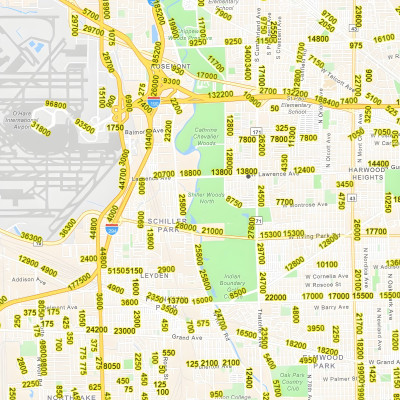
- State Departments of Transportation publish interactive maps showing ADT/AADT for major roads. For example, the Illinois DOT lets you click any road segment and see traffic volume.
- County and city planning or economic development departments can provide counts and past studies.
- Commercial real estate brokers often include traffic counts in listings.
- If data is sparse, you can do a short manual count during peak hours and extrapolate.
Pro tip: don’t be shy about calling the city or county office. Local governments want your business to move into their town. They’ll usually help you find the right traffic data and may share additional economic development resources.
Many variables determine success
Traffic counts are critical, but they aren’t the whole story. Each site is unique, and many factors influence whether a wash succeeds:
- Ingress/egress: simple right-in/right-out and safe left turns. Hard access kills capture rate.
- Visibility: clear line-of-sight from the road; avoid hidden or recessed bays.
- Zoning & utilities: confirm commercial car wash use, water/sewer capacity, drainage, and electrical service.
- Demographics: affluent renters or apartment dwellers are ideal customers, since they often lack a place to wash their cars at home.
- Competition: nearby washes can split traffic, though newer equipment and cleaner bays can help win customers.
- Room for expansion: build bays large enough so you can convert one to an automatic later if demand warrants.
- Climate and seasonality: usage changes with weather. In warm, sunny markets, self-serve demand is steadier year-round. In colder markets like Chicago, deep freezes can limit self-serve usage for stretches of winter unless the site is engineered and operated for cold weather (heated floors/loops, proper bay enclosure, anti-freeze protocols). Budget seasonality into your projections.
How many washes can a bay handle?
Wash counts aren’t the same everywhere—weather, traffic, and customer habits all matter—but you need a ballpark to plan.
- A typical self-serve wash takes 5–10 minutes. In theory, one bay could push 200 cars in 24 hours if it ran non-stop, but that never happens.
- Real-world averages are closer to 40–60 washes per bay per day. On peak days (weekends, after snowstorms or pollen events), a bay might hit 80–100.
- A safe planning number is about 50 washes per bay per day on average across the year. In cold-climate cities, plan a lower winter average and a higher spring surge.
This matters because during peak hours customers won’t wait—if all bays are full, they drive away. That’s why adding an extra bay can dramatically improve capture and revenue, even though fixed costs don’t rise much.
How much traffic do you need?
The type of wash you’re building determines how much traffic you need to make it viable. These ranges are guidelines, not guarantees—every location has its own mix of variables.
| Wash type | Recommended daily traffic | Typical setup |
| Self-serve | 8,000–15,000 cars/day (can work with less if you’re the only wash in town) | 2–4 bays with vacuums |
| In-bay automatic (rollover) | 15,000–20,000+ cars/day | 1 automatic bay, sometimes with self-serve bays attached |
| Express tunnel | 25,000–35,000+ cars/day | Conveyor tunnel with high throughput |
2 bays vs. 3 bays: what’s the difference?
A 2-bay wash is the smallest viable setup. It gives customers an alternative if one bay is full, and it spreads fixed costs across two revenue streams. However, revenue potential is limited, and you may struggle if competition moves in or during peak surges when customers won’t wait.
A 3-bay wash gives much more breathing room. With an extra bay, you capture more traffic during peak times and increase throughput without tripling your costs. The equipment room, utilities, and site prep don’t increase linearly, so the third bay often provides better return on investment compared to staying small.
Example scenario: 2 bays vs. 3 bays
Consider two sites with similar costs:
- Site A: 10,000 cars/day. At a 1% capture, that’s about 100 washes/day. With 2 bays, assume an average of ~50 washes per bay per day at $5 average spend ≈ $500/day or about $15,000/month before expenses. Winter in a cold market could pull that monthly average down; spring can push it up.
- Site B: 16,000 effective cars/day (corner math applied). At 1% capture, that’s about 160 washes/day. With 3 bays, the site can handle peaks better. At the same $5 average, ~160 × $5 ≈ $800/day or about $24,000/month before expenses.
Both sites carry similar fixed costs (insurance, signage, chemical systems, equipment room). The extra bay at the stronger-traffic site materially increases throughput and resilience, which can be the difference between scraping by and turning a healthy profit—especially when winter knocks out some self-serve days in cold climates.
Corner lot math: do you add the traffic?
At intersections, it’s tempting to add the two street counts together (example: 12,800 on one road and 13,800 on the other). Don’t simply add them; many vehicles overlap as they turn or use both roads.
- Use the higher-volume road as your base.
- Add 10–30% of the other road’s count for secondary exposure, depending on how easy it is to enter from that side.
Example: primary 13,800 cars/day + ~20% of 12,800 (≈2,500) = effective exposure ≈ 16,300 cars/day. That’s typically enough to support a 3–4 bay self-serve site and can justify planning for an in-bay automatic later.
The bottom line
Traffic volume is king. A high-visibility corner lot is great, but only if the cars are there. Add in demographics, access, competition, climate, and room for growth, and you’ll see why no two sites are the same. Do the math, weigh the variables, and build the right size wash for your market—whether that’s a lean 2-bay starter or a 3-bay setup with room to grow.
When you’re ready to outfit your bays, Car Guy Garage can help with the equipment side—from self-serve hardware and vacuums to payment systems and future-proof options that make upgrading easier.