

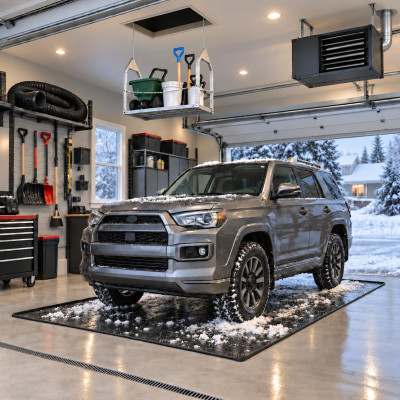
It’s that time of year when the seasons begin to change, the air turns crisp, and the good television finally comes back on. Before winter weather arrives, take some time to prepare your garage for the colder months.
A few practical upgrades can help you organize seasonal items, protect your garage floor, keep the space comfortable, and work more safely throughout the winter.
Clear the Floor with an Attic Lift
Start by getting the lawn chairs, plastic flamingos, sports equipment, and other warm-weather items off the garage floor. If you have usable attic space above your garage, an attic lift can make seasonal storage much easier.
An attic lift is a motorized platform that moves boxes and other stored items between the garage floor and attic. Instead of carrying bulky containers up a ladder, you can load the platform at floor level and raise everything into the attic. When it is time to decorate for the holidays, the lift makes bringing those boxes back down just as convenient.
Before choosing an attic lift, measure the height from the garage floor to the attic floor and confirm that your attic has enough accessible space for the lift and its platform. Car Guy Garage carries models designed for garage ceiling heights ranging from approximately 8 to 17 feet, along with corded and wireless control options.
Installation requirements vary by model and may include cutting and framing the ceiling opening, securing the lift to the structure, building a stable attic-floor landing area, and providing the required electrical connection. Always follow the manufacturer’s installation instructions and local building requirements. If you are uncertain about the framing or electrical work, consult a qualified contractor or electrician.
Protect the Garage Floor from Snow and Slush
Once the garage floor is clear, the next step is protecting it from the mess winter brings.
Snow, road salt, mud, and slush collect beneath a vehicle as they melt. Without containment, that dirty water can spread across the garage floor, reach stored belongings, and leave salt residue and stains behind.
A garage floor containment mat has raised edges that hold water, slush, mud, and debris within the vehicle’s parking area. The mat can then be cleaned according to the manufacturer’s directions instead of allowing the mess to spread throughout the garage.
Before ordering, measure the entire area you want the mat to cover—not just the dimensions of the vehicle. Choose a mat that provides additional length and width around the vehicle so you have some margin when parking and enough coverage for runoff near the tires, bumpers, and wheel wells.
Car Guy Garage offers the raised-edge containment mat in four sizes, making it easier to find the right fit for anything from a compact car to a larger truck or SUV.
View Raised-Edge Garage Floor Containment Mats
Make the Garage Comfortable with a Heater
A clean, organized garage is much more useful when it is warm enough to enjoy. Whether you use the space for vehicle projects, woodworking, detailing, watching the game, or simply escaping the house for a while, the right heater can make the garage comfortable throughout the colder months.
Two common options are forced-air heaters and radiant tube heaters.
Forced-Air Garage Heaters
A forced-air heater uses a fan to circulate heated air throughout the garage. These heaters warm the air quickly and are a popular choice for typical residential garages and workshops.
Most garage unit heaters are self-contained and do not require existing household ductwork. However, installation requirements vary depending on whether the heater uses natural gas, propane, or electricity. Fuel-burning models may require a gas connection, proper venting, combustion air, and electrical service for the fan and controls.
Radiant Tube Heaters
Radiant tube heaters use infrared energy to warm people, vehicles, tools, floors, and other surfaces directly instead of relying entirely on heated air.
This can be helpful in garages where the overhead door is opened regularly. Although some warm air will still escape, the objects and surfaces in the garage retain heat and continue radiating warmth after the door closes.
Radiant tube heaters require appropriate mounting height and clearance from vehicles, storage, lifts, and combustible materials. Larger systems are frequently used in commercial shops or residential garages with high ceilings.
Whichever style you choose, consider the garage’s square footage, ceiling height, insulation, climate, available fuel source, and required clearances. Heating equipment should be sized correctly and installed according to the manufacturer’s instructions and applicable codes. Gas-fired heaters should generally be installed by a qualified professional.
Still deciding which type is right for your space?
Read: Forced-Air vs. Radiant Garage Heaters
Safely Manage Vehicle Exhaust
Once the garage is warm, you may be ready to spend the winter working on your project car. If that work requires the engine to run, vehicle exhaust must be addressed properly.
Gasoline and diesel exhaust can contain carbon monoxide, an odorless and colorless gas that can cause headaches, dizziness, weakness, nausea, confusion, unconsciousness, and death. Exhaust can also enter the home from an attached garage.
An automotive exhaust-extraction hose captures fumes at the vehicle’s tailpipe and carries them to an approved discharge point outdoors. For occasional work, this may involve a properly sized, temperature-rated hose connected securely to the tailpipe. More advanced systems can include Y-connectors, hose splicers, overhead hose drops, reels, door ports, and equipment for servicing multiple vehicles.
The hose must be compatible with the vehicle’s exhaust temperature and tailpipe size, remain securely connected, and discharge completely outside where fumes cannot reenter through doors, windows, or vents. It should not be pinched or damaged beneath a garage door.
An exhaust hose is not a substitute for proper fresh-air ventilation, safe operating practices, or working carbon monoxide alarms. Never assume that a connected hose makes it safe to operate a vehicle in a sealed garage. Follow the equipment manufacturer’s instructions and all applicable safety requirements. Vehicles should never be left running unattended, and public-health guidance advises against running a vehicle inside an attached garage.
Car Guy Garage carries individual exhaust hoses, complete kits, adapters, splicers, door ports, hose drops, and components for single- and multi-vehicle installations.
Shop Automotive Exhaust Hoses and Extraction Equipment
Get Your Garage Ready Before Winter Arrives
A little preparation now can turn your garage into a cleaner, warmer, and more useful space throughout the winter.
Clear away seasonal clutter, contain the snow and slush, choose the right heating system, and make sure any vehicle exhaust is handled safely. Then you’ll be ready to watch the games, hide from your in-laws, and work on your project car without waiting for spring.