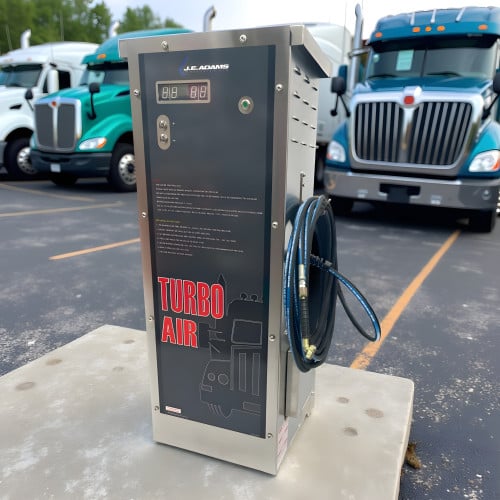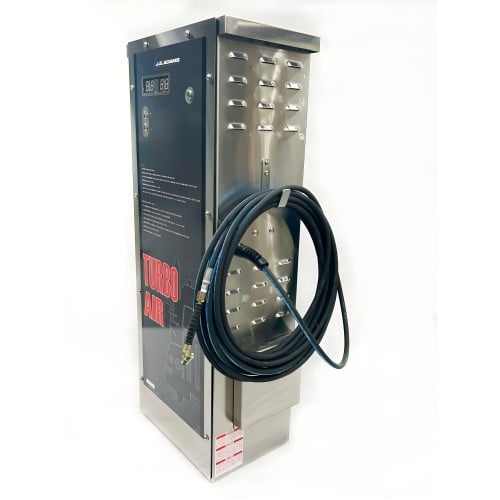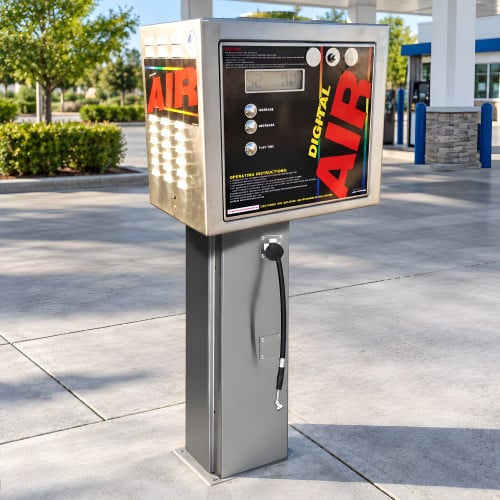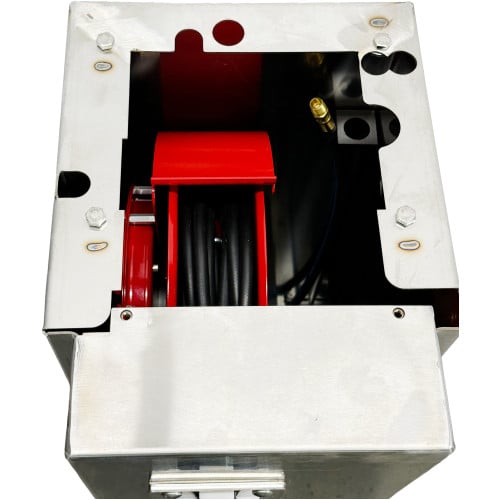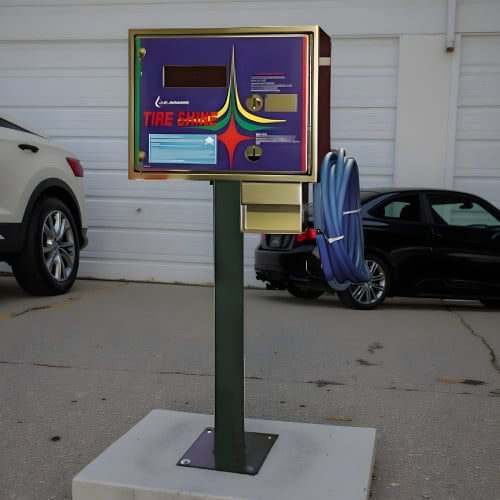
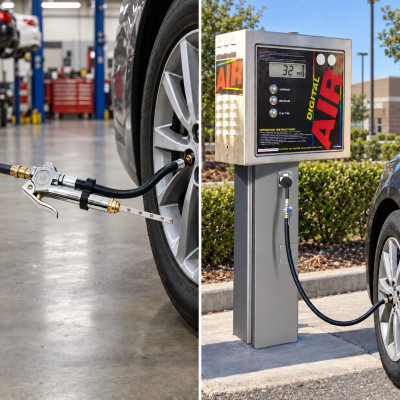
Commercial tire air machines are available with either a mechanical gauge attached to the hose or a digital pressure-control system built into the cabinet. Mechanical machines generally cost less upfront, while digital machines can be easier for customers to use and may experience less downtime caused by damaged hose-mounted gauges.
The better choice depends on where the machine will be installed, who will use it and how closely the equipment will be supervised.
How a Mechanical Tire Air Machine Works
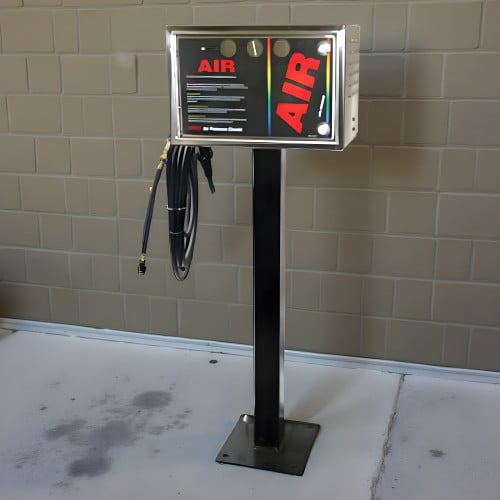
A mechanical machine places the pressure gauge near the air chuck at the end of the hose. The customer connects the chuck to the tire, watches the gauge and manually adds air until the desired pressure is reached.
This is a simple and familiar system for someone who has experience inflating tires. It can work well at a private fleet yard, repair shop or other controlled location where employees know how to operate the equipment.
The disadvantage is that the gauge travels with the hose. At a public or unattended location, it may be dropped on the pavement, dragged, exposed to weather or driven over. A gauge can also become inaccurate after repeated impacts even when it does not appear completely broken.
Because the gauge is necessary for safe operation, damage can leave the entire machine unusable until the gauge is repaired or replaced.
How a Digital Tire Air Machine Works
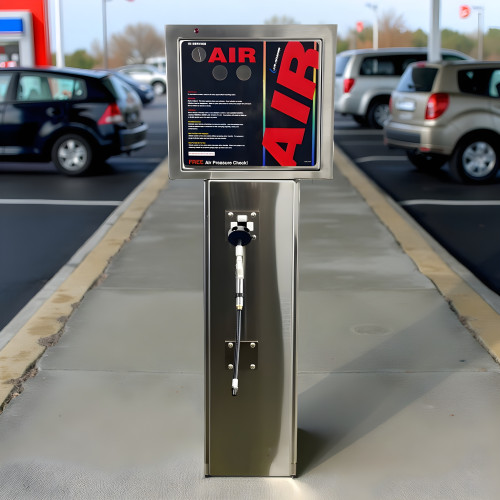
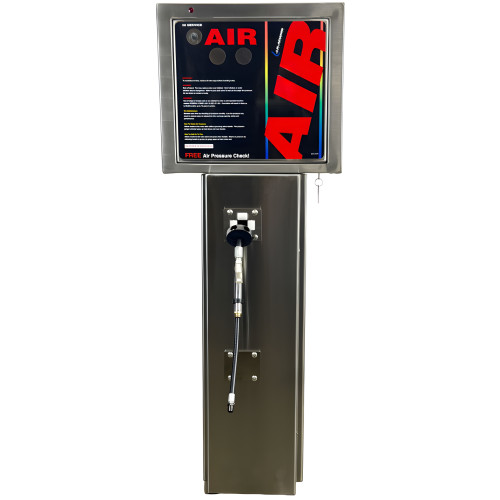
A digital machine places the pressure display and measuring system inside the cabinet. The customer uses buttons on the machine to select the desired pressure and then connects the chuck to the tire valve.
The machine delivers air and periodically pauses to sense pressure from the tire. It continues until the selected pressure is reached. Some models also sound an alarm to tell the customer that inflation is complete.
The brief pauses in airflow are part of normal operation. They allow the machine to measure tire pressure before adding more air.
The customer must still select the correct pressure. The vehicle manufacturer’s recommended cold tire pressure is normally listed on a placard inside the driver’s door jamb and in the owner’s manual. The maximum pressure printed on the tire sidewall is the tire’s limit at its rated load, not necessarily the vehicle’s recommended operating pressure.
Digital Operation Is Often Easier for the General Public
Many drivers today have little experience using mechanical tools, but they are comfortable entering numbers and pressing buttons on phones, payment terminals and other digital devices. For these customers, selecting a pressure on a digital display is often more intuitive than trying to read a small mechanical gauge while controlling the airflow manually.
The process is straightforward: find the vehicle manufacturer’s recommended cold tire pressure on the placard inside the driver’s door jamb, enter that number on the machine and connect the chuck to the tire. The machine then manages the inflation process and indicates when the selected pressure has been reached.
A mechanical gauge requires the customer to watch the reading, operate the inflator and decide when to stop. An experienced driver may find that easy, but it can be confusing for someone who rarely checks tire pressure. Some users may add air in short bursts, remove the chuck repeatedly to check the reading or stop before the tire reaches the correct pressure.
Digital operation removes much of that uncertainty. This can produce a better experience at gas stations, car washes, apartment communities and other locations where the machine will be used by drivers with widely varying levels of mechanical knowledge.
Upfront Cost Compared With Downtime
A mechanical tire air machine will generally have a lower purchase price. For a business primarily concerned with initial cost, it may be the more economical choice.
A digital machine costs more because it includes a pressure sensor, display, control board, buttons and solenoids. However, its pressure display is protected inside the cabinet instead of being attached to the end of the hose.
That protection may reduce downtime at busy or unattended locations where broken mechanical gauges are a recurring problem. The decision should therefore consider both the initial purchase price and the cost of having a machine unavailable while a damaged gauge is replaced.
When a Mechanical Machine Makes Sense
A mechanical tire air machine may be a good choice when:
- The machine will be used mainly by employees or experienced fleet drivers
- The location is supervised
- Usage is relatively low
- Lower upfront cost is a priority
- Simple manual operation is preferred
When a Digital Machine Makes Sense
A digital tire air machine may be worth the additional cost when:
- The machine will be available to the general public
- Many users may have little experience inflating tires
- The location is unattended
- Usage is frequent
- Hose-mounted gauges have been damaged previously
- A simple button-based process is preferred
- Downtime would inconvenience customers or reduce revenue
Making the Final Decision
Mechanical tire air machines offer a lower upfront cost and straightforward operation for people who already know how to use a tire gauge. They are often a sensible choice for controlled locations with experienced users.
Digital machines require a larger initial investment but protect the pressure display inside the cabinet and give the public a more familiar button-based experience. At a busy public location, easier operation and the potential reduction in gauge-related downtime may justify the additional cost.
Compare commercial tire air machines available from Car Guy Garage.